A split-second collision in the surf tested fifteen years of military conditioning. What held wasn't luck. It was readiness, trained in advance.
What fifteen years of military conditioning taught my body to do in a fraction of a second, and what I've kept training for since.
There was a moment this week when my whole life slowed down. Frame by frame, I watched a collision become inevitable. It would happen. It couldn't be avoided.
But in the seconds I had left, I could still change how hard it landed.
Fifteen years of building for a moment like this
Fifteen years of full-time military service, training as an operator of hardware and systems that feed the war machine. A further five years part-time, raising a family alongside it. Much of that training was routine: the deliberate mental and physical reset required to shift from a civilian to a military-grade human.
We ran in boots with heavy packs. We carried each other on stretchers up hills. We dug trenches and slept in them, sleep-deprived, tracer fire lighting the dark and punctuating the air with sound, specifically to keep us from sleeping.
I watched other young soldiers hallucinate insects crawling out of the soil toward them, in their sleep-starved, brain-addled states. Inventing threats that weren't there.
I've run in a chemical and biological warfare suit, breathing through a straw for water, gasping inside an inflatable seal built to withstand whatever an enemy might drop from the sky to torture and demoralise the front line. I've rehearsed engine failures until the dead silence of a stopped engine holds a strange half-second of peace, before the brain floods the body with everything it has to do to save the aircraft and the people in it.
Despite all of it, and much more behind me, ingrained now in my body's memory, in the ordinary hum of daily life in a small town, I often think about how desperately ordinary I am.
I get mad when my children leave a mess on the floor. I binge on chocolate. I have long stretches of boring days strung together. Sometimes I fantasise about walking away from my life altogether and living alone in a small, minimalist cottage on a hill.
And then there are days like Wednesday, when something happens that refuses to follow a logical, statistically likely path to the foreshadowed undesirable outcome.
An ordinary Wednesday, until it wasn't
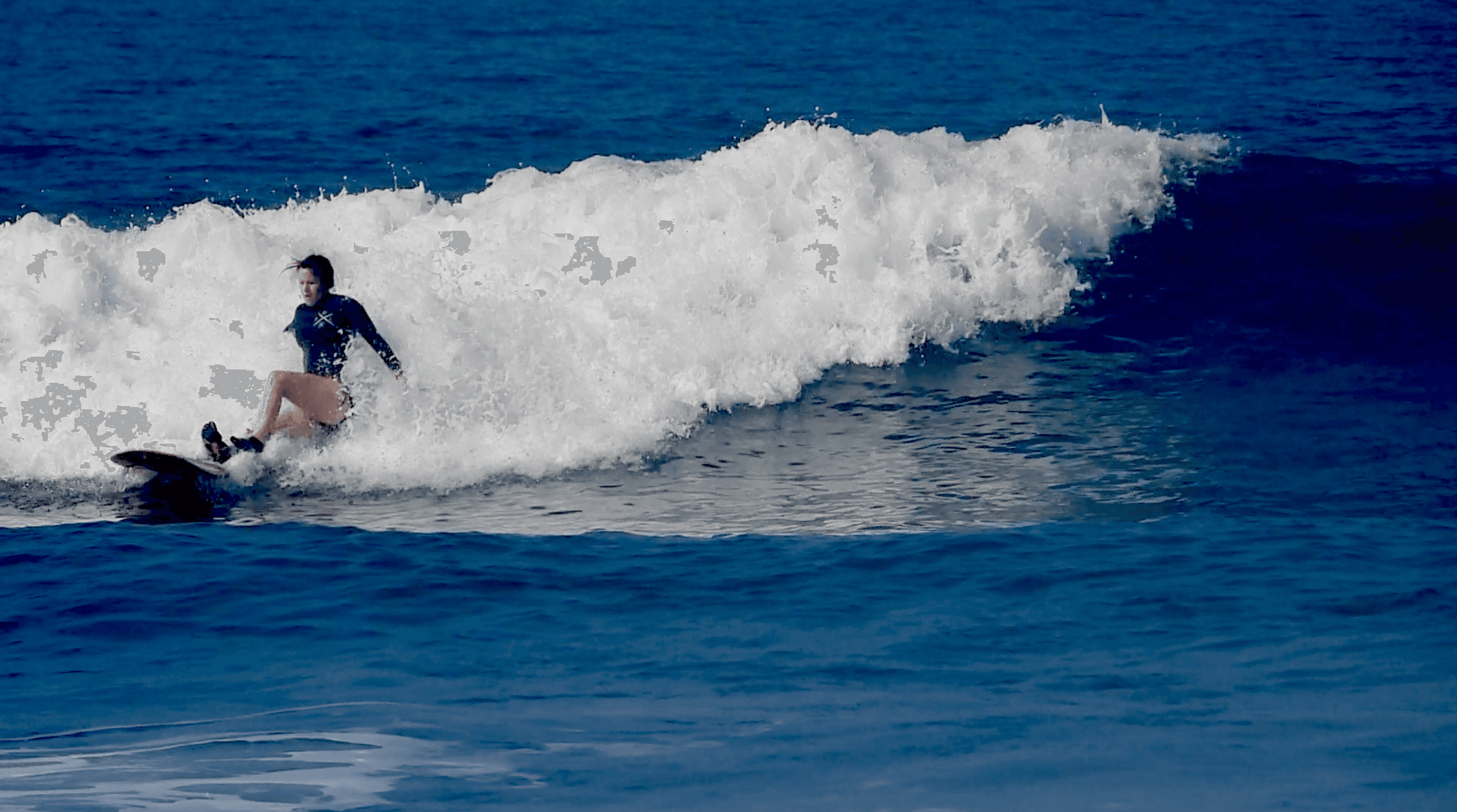
It was an ordinary Wednesday morning. I got the kids to the bus and headed out for a surf. Paddling through the beach break, I watched the pack, watched the peak, watched the green rolling shoulders, working out anew where the banks and channels had reformed around this ever-shifting stretch of coast.
Raglan. Ngarunui. World-famous since 'The Endless Summer', a cult surf film that put it on the map decades ago. Home, for six years now.
Kate waved at me from behind the breakers. My best friend, a surf-obsessed mother of two with mediocre skills, just like me. I watched a set roll through the pack, knowing I'd take this one on the head. Too far out to retreat to the beach, not far enough in to get behind the curling lip and the torrential whitewash.
I watched Chris, a local dad, pick the perfect peak and take off. He carved a clean roundhouse cutback across the full height and breadth of usable green shoulder. Beautiful.
Even from thirty metres out I could see this shoulder would reach me in perfect form, with Chris still on it. We were on a collision course.
I watched his every move, reading his body language, willing him to look up so I could read his path and get out of the way. Another cutback. I couldn't get inside him, under the whitewater, it was too far left. I couldn't predict his line because his speed kept changing, so moving right wasn't an option either.
Chris, look up! I silently willed.
The fraction of a second
The moment I thought he might hear me, I shouted: Chris!
Every fibre of him was locked onto his bottom turn. I still couldn't predict his path. I needed him to see me, to make the silent, eye-to-eye collision-avoidance agreement surfers make with each other, over and over, without ever discussing it.
Chris!
His body was wound tight, tipping forward, perfectly balanced. Time slowed down. I saw the call land in his brain. He looked up, stabilising out of his turn, and I watched his face change in slow motion as he registered me there. His face told me everything: he couldn't change direction in time. Mouth open, eyes wide.
I understood, in that instant, that only I could change how this ended.
Time arrived in snapshots as every option to get clear failed, one after another. Too slow to duck-dive. Bailing the board wouldn't guarantee a miss, and it would certainly hurt him. Moving left or right was too slow to matter.
I had a fraction of a second.
I rolled, bringing my board up like a shield against the wave and the body both closing on me like a missile, and pulled it over myself as they hit, together, at once. I didn't try to hold it. I let it fly, absorbed the impact, crossed my arms over my face, and folded into as small a shape as I could make in the water.
Boards and bodies churned in a rough washing machine, and then, suddenly, quiet. As I surfaced, I heard Chris calling out, urgent. He knew it had been serious. When my face broke the water, I saw him swimming hard towards me.
I called back in relief. It hadn't touched me. Hadn't even grazed me.
We pulled our boards in, untangling the leg ropes. As the adrenaline faded, I scanned my body for injury. Nothing. He kept apologising. I shook my head. No fault, this happens, I'm fine, it's just surfing.
Paddling back out, we talked through what either of us could have done differently and came up with nothing. No one was wrong. No one made an unskilled choice. A worse outcome was avoided by one quick manoeuvre.
What I actually noticed
What stayed with me wasn't the manoeuvre itself. It was the frame-by-frame clarity going into it: a clear read of the options in what must have been microseconds, no trace of panic, just an ordered, sequential process of assessment and elimination, followed by a near-perfect execution of impact mitigation.
Later, I found where his board had skimmed the underside of mine: a deep, perpendicular cut in my rail, cut by his fin, exactly where my head would have been if I hadn't rolled and turned the board into a shield.
Years of conditioning the body to respond under pressure held their weight, right when it mattered.
The frame-by-frame decision paths I'd rehearsed as critical failures in an aircraft made the options visible. The body, conditioned to respond under pressure, answered on demand, without being asked twice.
The conditioning never stopped; it just changed shape
Maybe it didn't save my life on Wednesday. Maybe it just saved me a beating. But sitting out the back, waiting for the next set, watching fog roll over the coastal cliffs and the green farmland behind them, I found myself thinking about the power of conditioning.
One heroic surge, the effort of a single day or a single week, adds up to very little across the span of decades. What compounds is what you repeat.
So I asked myself what I had actually been conditioning, in the years since I left full-time service. And there it was. I never stopped training for readiness. Only the shape of the training changed.
The Take
Readiness isn't a single skill you either have or don't. It's a condition you build in advance, so there's nothing left to decide when the moment arrives.
One heroic surge doesn't compound. Repeated, deliberate conditioning does: that's the entire difference between an adrenaline win and Performance Integrity.
The training that shows up under pressure was never a bonus effort. It was already there, waiting to be spent.
What are you conditioning yourself for?
Continue reading: Optimisation Is Fragile. Readiness Is a Responsibility, the framework behind this story. Or explore: the Core Power approach to see how Energy, Execution and Scale build performance that holds under real pressure.