Overwhelm rarely kicks down the door; she seeps under it, shrinking capacity until a child’s question feels like shrapnel. Three body-based resets reopen space before crisis storms in.
One Breath to arrive. Here I am.
One Breath for the body. Here I feel.
One Breath for my mind. That winding labyrinth of threads.
One to arrive.
One to still the body.
One to still the mind.
As I come into awareness, the incessant running of water over river stones arrives first. An always-there roar that is somehow imperceptible when the mind is hyperactive. Yet in stillness it is a most persistent sound that colours the aural landscape. It appears to morph as the air that carries it changes shape, sometimes muted and soft, like the mossy banks and sometimes tinkling and sharp.
The sensation that arrives next is the cool touch of the breeze on bare skin, a cutting contrast to the syrupy warmth of the spring sunshine. As this winter is shuffled into the shadows by the increasingly warm rays of the sun, the breeze retains the cold breath it collects from the ocean and the rocks it kisses as it funnels up the valley. The smell of warming grasses and spring flowers arrives on the wings of the invisible.
Hear.
Smell.
Touch.
Taste and sight remaining unexplored.
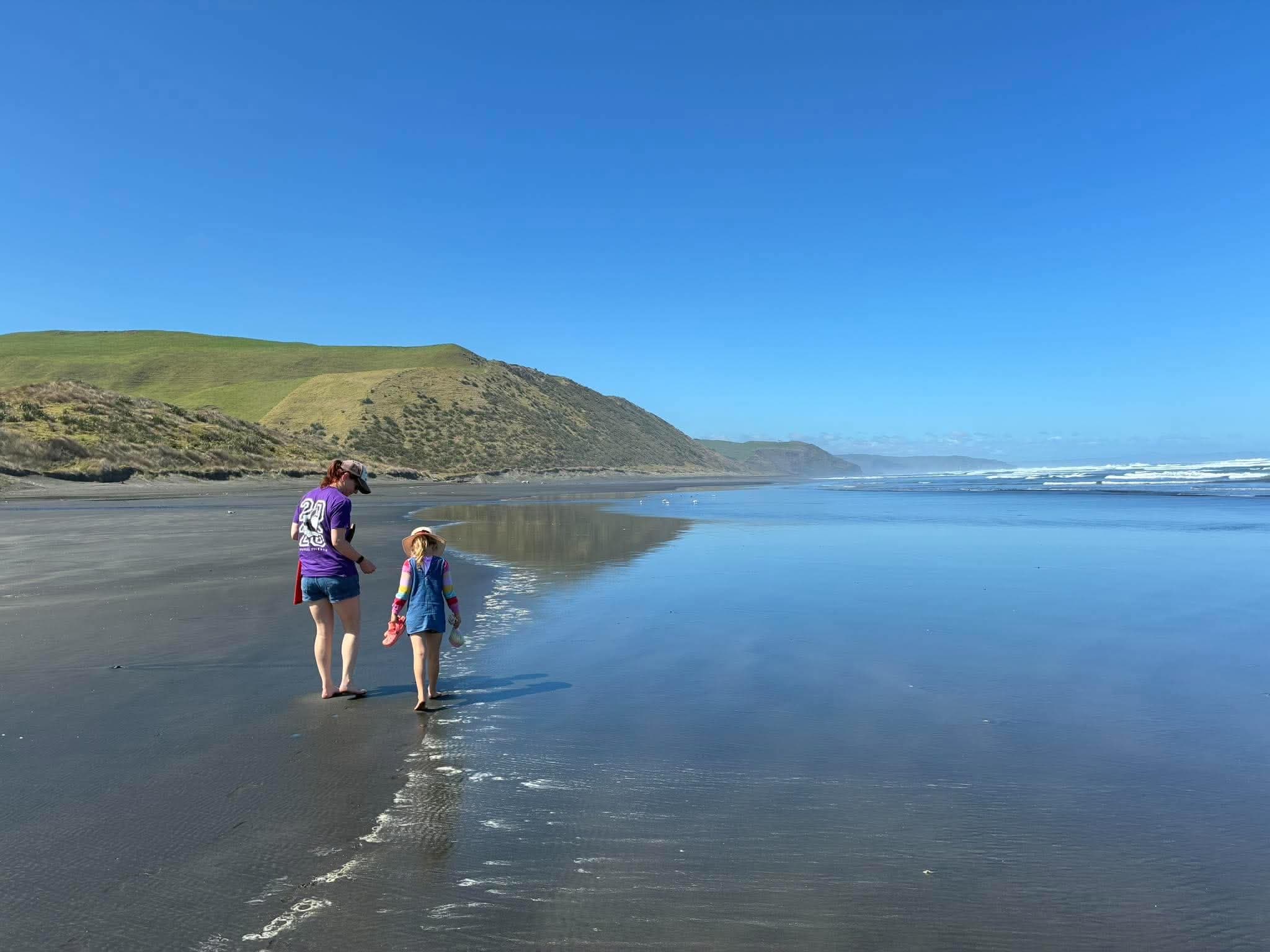
I see green everywhere the eye rests. Now I've called it into consciousness, it's all I can see. The luscious grass-covered New Zealand pastures, the evergreens on the skyline, the bright green shoots awakened by the new-spring sunshine. A vista of green. A feast.
Taste. What can I taste? The faint metallic undertones in my saliva of anxiety. Even using that word sends a signal through my nervous system and something near my heart pulses, a small squeeze of adrenaline is added to the bloodstream and carried onwards by a heartbeat.
Anxiety, that's why I'm writing. That's why I'm here, slowly stepping through this sensing exercise. 5 senses. 5 points of focus that are not the overwhelm that has flooded my body the last few days. Taste, See, Smell, Hear, Touch.
The immediacy calms me. Inside this moment, I am still. I am safe. The anxiety and overwhelm sit outside this bubble.
I clothe myself in it, those feelings belong to the world outside this moment. And here, in this place I created for myself, I have a moment of respite.
Two days earlier
Life is busy. Kids, husband, work, finances, domestics, the international travel that comes with being an emerging speaker and a RAAF pilot. All of the threads are heavy this week, demanding, seemingly consequential. I have been flirting with this overwhelm for a while now - perimenopause, they say - a sense of constriction where only appetite and thrill used to exist before.
It's interesting that what landed heavily just two days ago was a matter of the heart. The logic filter I am wont to shape my life through fractured, and overwhelmed grabbed hold, pulling unevenly on the labyrinth of threads that I had delicately balanced in my mind.
It matters not the cause. For each human, the thread that pulls the whole tapestry into chaos is different. But I write this because the shape of recovery for all of us follows the same pattern.
It's this, dear fellow operator. The chance that I might share something of value to another operator of the human body.
Overwhelm is an epidemic of the 21st-century first-world lifestyle and workplaces. A record 44% of the world's workforce now reports significant daily stress, the highest figure Gallup has ever recorded in the survey's history. Closer to home, 39% of employees say they've felt overwhelmed in a way that directly affected their job performance, according to the 2026 NAMI-Ipsos Workplace Mental Health Poll.
What I see in our future is work that grows in complexity and demands more of our capacity every year. Not just because of what our workplaces demand of us, but because of what society expects of us too. And that's just the trends that are already playing out.
Technology and AI integration, geopolitical instability and increasingly complex human needs as change gathers pace, families fracture from the traditional nuclear models mirrored on the world stage by the breakdown of the last 50 years of world order. No wonder we're overwhelmed; my heart is squeezed just putting that down on paper.
And so, it becomes increasingly important to sense when overwhelm has arrived. She rarely comes in the front door with flourishing trumpets and an entourage - that's her sister Crisis. Overwhelm is the early warning sign, and she floats gently under the door jambs and slowly takes up more and more space until we realise we feel constricted by something we can't quite see or touch.
For me, I recognise overwhelm in a brain that doesn't stop being busy. I sit in strategy, not heart, intentional, calculated, logically sound. But cut off from the rich sensations of my body. I feel it in the reduction of capacity for the unexpected and the interruption.
Mum, I neeeeeed you. Where's my teddy? We need to talk. No, I disagree.
Phrases that cause irritation, in place of curiosity. That's when I know overwhelm has arrived and is filling the spaces where capacity usually belongs.
What are your capacity-restricted tells?
And how do you build that space back for yourself?
There are three strategies I leaned into on that day, sitting by the stream on the green green grass of newly sprung spring. Two days later than when Overwhelm first began her slow strangulation of my joy. Three strategies that drew me out of my busy brain and back into my body and grounded presence.
This was the first.
3 Breaths
One to arrive.
One for the body.
One for the mind.
Do this every time the breath feels tight or the body tense. Do this every time the thought arrives.
5 Senses
Hear. Feel. See. Touch. Taste.
I start by turning in to sounds. It makes me be still to catch the sounds, and that helps the other senses arrive.
Writing
This long, intuitive therapy sculpts words and scattered fragments of thought into an integrated, malleable narrative that is preferable to chaos. We are meaning makers. We need story. Write it, and it is. Write it to have overwhelm flow through you and onwards. Write it to shape how you want it to sit in memory and self-narrative.
Immersed in this green vista, kissed by the cool breeze and embalmed in sunshine, a persistent tumbling in my ears that now begins to sound like the laughter of water, the suffocation of overwhelm disappeared. I found in my body's senses, and in the breath filled with spring, a relief.
And with that relief, my capacity began to be restored.
Sources
Gallup, State of the Global Workplace 2026. A record 44% of the world's workforce reported significant daily stress, the highest figure Gallup has recorded, from a sample of 263,810 respondents across more than 140 countries, collected across 2025.
2026 NAMI-Ipsos Workplace Mental Health Poll. 39% of full-time employed adults say they've felt overwhelmed in a way that directly affected their job performance, from a sample of 2,153 respondents at companies with 100 or more employees, fielded late January to early February 2026.